Scooter Conversions
Electric conversions and Chimera builds for classic scooters
Innovatio Brutalis takes on scooter projects where classic form meets a modern driveline or where the mechanical package becomes the entire point. The focus is electric conversion of classic scooters and Chimera twin-cylinder builds for Lambretta. Every project is built around the donor vehicle, target brief and real-world use, with attention to engineering, integration, finish and riding feel.
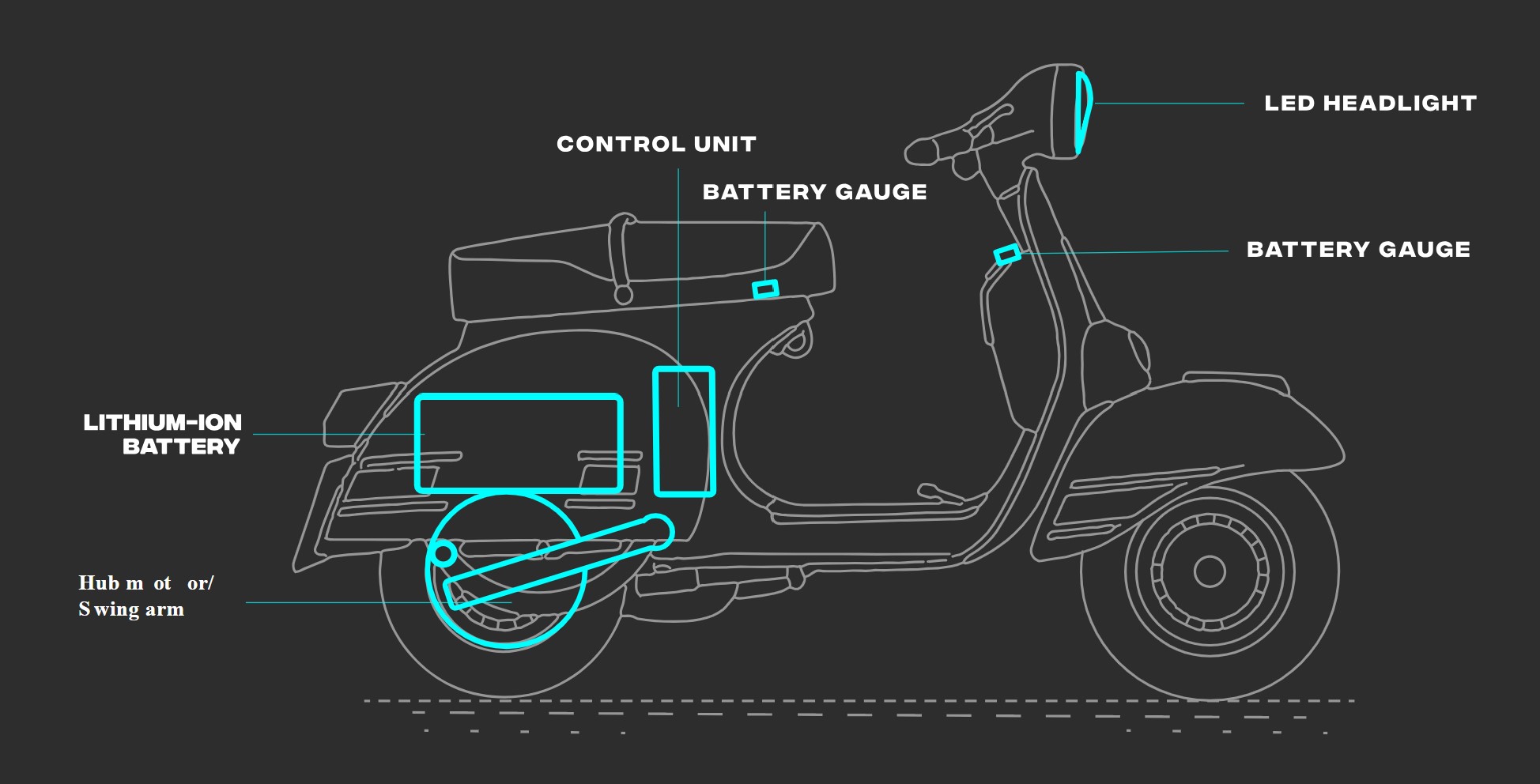
Electric conversion
Electric conversion of classic scooters
For owners who want to keep proportions, stance and visual identity while replacing legacy drivetrain friction with a more usable system. The solution is assessed around model, condition, use case and how the integration needs to work in real use.
- Classic look with a modern, quieter driveline
- Removable battery solutions and straightforward daily charging
- Less mechanical maintenance than traditional combustion drivetrains
- Discreet integration into bodywork, electrics and controls
- Assessed per Vespa, Lambretta or other relevant platform
- Technical review before quotation when the project goes beyond a simple kit-based route
Technical Overview
Project-based electric conversions are built around a 4 kW-class brushless driveline with sinusoidal motor control, a custom swingarm and a battery holder or battery tray depending on model. Integration normally includes keyless ignition, a digital battery gauge, LED lighting conversion and an upgraded rear brake with disc brake where platform and project layout justify it.
Battery system and range
Common battery configurations use 72V systems in 31Ah, 35Ah or 50Ah form, corresponding to approximately 2.2 kWh, 2.5 kWh and 3.6 kWh respectively. Practical range typically falls in the region of 50-90 km depending on battery size, scooter platform, rider weight, tyre choice and riding style.
Performance and use case
Performance is specified per project and should always be understood as dependent on donor vehicle, driveline and integration level. Top speed can in some configurations reach up to around 100 km/h, but the actual figure is always determined by chosen platform, gearing, battery system and intended use.
Charging and day-to-day use
Charging is handled via an external charger from a normal household socket. Batteries are removable and, in many configurations, can also be charged on board. Some setups support charging levels where roughly 70% can be reached in around 1 hour and a full charge in about 2.5 hours, depending on the selected battery and charger specification.
Platform adaptation
Battery count, battery placement, charger solution, onboard charger storage and overall integration level vary with the Vespa or Lambretta platform, available packaging space and the character the finished project is meant to have.
Choices and Options
- Battery size is specified around model, use case and desired practical range
- Battery count is chosen around available space, weight balance and target energy capacity
- Battery placement is resolved per platform, bodywork and service access
- Onboard charging or a separate charger solution is chosen according to integration level
- Charger storage is planned around packaging and day-to-day use
- Platform adaptation is carried out for Vespa, Lambretta or another relevant scooter base
- A technical review is carried out before quotation when the project requires deeper pre-study
Platform Support for Electric Conversion
Below is the supplier's stated platform support. It is a useful basis for an initial assessment, but every project still needs to be reviewed around donor vehicle, condition and how the integration is to be resolved.
Vespa small frame
Support exists for V50, 50 Special, V90, V100, Primavera and similar small frame models built 1963-1983, as well as many Spanish Moto-Vespa derivatives. The supplier also states that the kit is not available for PK models built 1983-1992.
Vespa large frame
Support exists for two main large frame Vespa groups. One covers GS 160, SS180, Rally 180/200, TS 125 and all PX/P-Range models, plus Spanish Moto-Vespa derivatives after 1965. The other covers VNA, VBA, VNB, VBB, GL, Sprint, GT, Super, Sprint Veloce and GTR, plus Spanish Moto-Vespa derivatives from 1958-1964 as well as Douglas Vespa 152L2 and Sportique.
Vespa wide frame, early 1950s models
Support exists for VM1T, VM2T, VN1T, VN2T, VL1T, VL2T, VL3T, VB1T, plus Vespa Douglas G, GL2, 42L2, 92L2 and Spanish Moto-Vespa models from 1952-1958. The supplier also lists support for US-market Allstate VA1T-VA8T and French Acma 125 and GL from the same period.
Vespa GS 150 wide frame
The GS 150 has its own separate kit. It is stated to fit VS1T-VS5T, which corresponds to the GS 150 series from roughly 1955-1962.
Lambretta Li / TV / SX / GP
Support exists for all Innocenti Li, TV, SX and GP models built 1958-1972, as well as Spanish Eibar and Serveta derivatives built 1960-1989. The supplier also states support for Indian Series 2 and GP models.
Lambretta D / LD
There is a separate kit for the D/LD series. The supplier states support for Innocenti D 1951-1956, Spanish model B, LD Mk1-Mk2, Spanish model A, all French LD models, and LD Mk2 from 1956 onward plus LD Mk3.
Lambretta J Range
Support exists for J50, J125, Cento and Starstream.
Producer reference: Project E at Retrospective Scooters
Reference Video
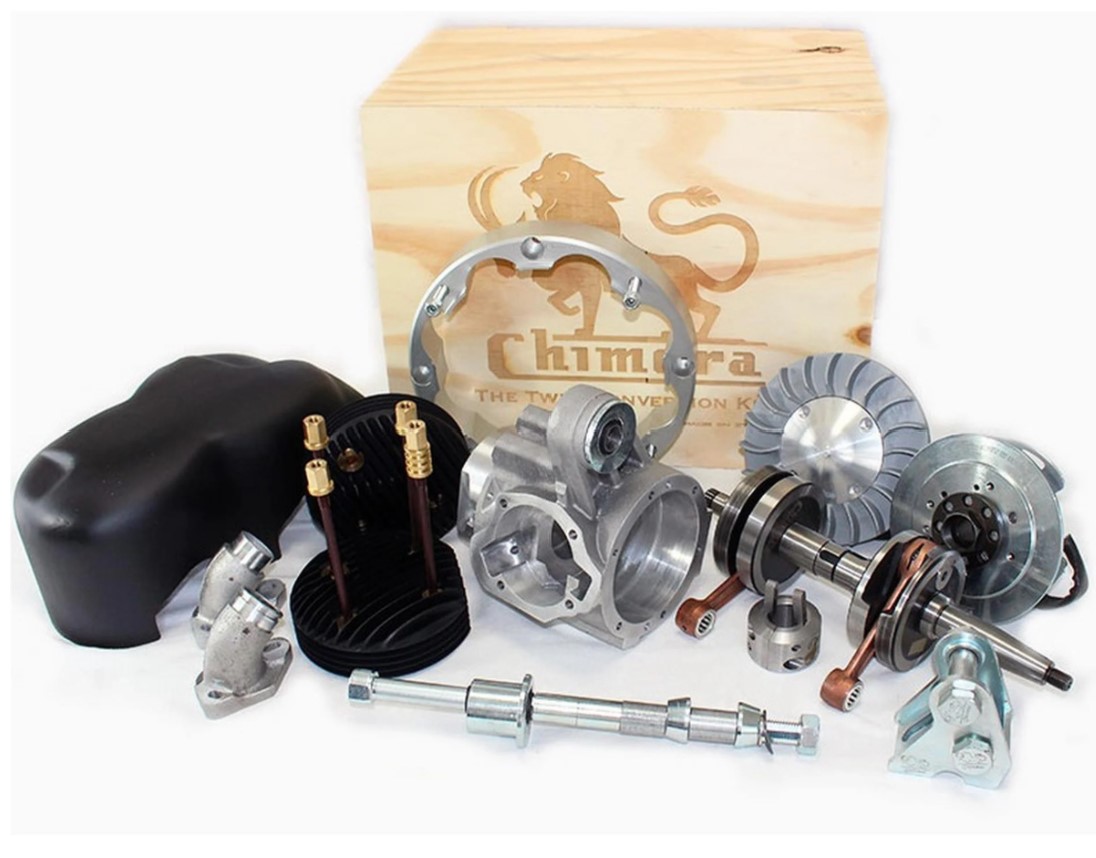
Chimera twin-cylinder
Chimera twin-cylinder Lambretta builds
For enthusiasts looking for more than a quick engine upgrade. Chimera builds are about twin-cylinder character, packaging, cooling, strength and a finished machine with a distinct identity.
- Chimera is offered for S1/S2/TV2 or S3/LIS/SX/TV3/DL, and in small block 125/150/175 or big block 200/225/250 form
- Intake layout is chosen around cylinder package: piston ported or reed
- Exhaust layout is chosen as 2-in-2 or STRAIGHT 2-in-1 depending on target brief and engine architecture
- Pre-study of crankcases, rear hub, short-type silent blocks and bodywork before the specification is locked
- Tailored around engine base, gearbox and target outcome
- Built as a sport and special build, not as a generic standard kit for every project
Chimera: Technical Choices Before Quotation
Chimera should not be described as a homogeneous bolt-on kit. Platform, crankcase, intake, exhaust layout and chassis modification need to be locked early if the project is to be right.
Four base kits
The official range is in practice divided into four base variants: S1/S2 small block for LI S1, S2 and TV2 with 125/150/175 crankcases, S1/S2 big block for the same model family with 200/225/250 crankcases, S3 small block for LI S3, LIS, SX, TV3 and DL with 125/150/175 crankcases, and S3 big block for the same family with 200/225/250 crankcases.
Series determines kit details
The first choice is which scooter family the build is intended for: S1/S2/TV2 or S3/LIS/SX/TV3/DL. That affects actual fitment, including CDI/regulator mounting and the right rear footboard or pedal support.
Crankcase choice is locked from the start
The next major choice is whether the project is built around a small block 125/150/175 or a big block 200/225/250 case. This is a base specification, not a detail that should be left undecided until later.
New-manufacture big block as an option
As an option, a Chimera project can be built around a newly manufactured UNI big block crankcase. That becomes relevant when an original engine is missing, when the starting material is too weak or when the project needs to begin from a new and clearly defined base.
Intake and cylinder package
Intake configuration is chosen around cylinder architecture. Chimera is offered for piston-ported cylinders and for reed cylinders with round connection, such as TS1-type layouts, both intended for 28/30 mm carburettors.
Exhaust connection and layout
On the exhaust side, the project needs to be defined as standard connection or TS1/round flange. From there the build is specified as either 2-in-2 expansion or STRAIGHT 2-in-1. The 2-in-2 route is the maximum-output path, while 2-in-1 prioritises stronger torque from lower rpm.
2-in-1 affects the chassis
STRAIGHT 2-in-1 is not just a matter of taste. The centre stand then needs to be removed in favour of a side stand, and the cylinders have to stay within the correct exhaust timing because both share the same manifold.
Rear hub and silent blocks must be correct
Chimera is dimensioned around the rear hub and drum brake from LI S3/LIS/DL and assumes LI short-type engine silent blocks for proper installation, regardless of whether the project starts from an S1, S2 or S3-based scooter.
Modification is part of the project
This should not be presented as a simple bolt-on kit. Correct installation requires modification of the original crankcase, rear footboards or pedals, side panels and the support for the rear footboard. On S1/S2 the installation is to a large extent reversible without frame modification, while S3 requires modification of the footboard arm for the engine package to fit. The manual also shows templates for cutting and drilling the crankcase.
Reed builds may require more space
Reed-based builds using TS1, Imola, Monza or RB cylinders may need extra attention around frame clearance. In those cases, offset solutions become relevant to create the required intake clearance.
Special build for sport-focused use
Chimera should be positioned as a sport build, performance build and technical enthusiast project. It is not correct to describe it as a general road-going standard solution for all users.
Practical Decision Flow
- Which scooter family: S1/S2/TV2 or S3/LIS/SX/TV3/DL.
- Which crankcase: small block 125/150/175 or big block 200/225/250.
- Which cylinder architecture: piston ported or reed.
- Which connection: standard or TS1/round flange.
- Which exhaust system: 2-in-2 or STRAIGHT 2-in-1.
- Are the correct rear drum and short-type silent blocks in place, or does that need solving before the project is locked.
- Is modification of bodywork and crankcases accepted; otherwise Chimera is the wrong project.
Producer reference: Chimera kit at Scooter The Fero
Reference Video
Dialogue and project brief
We start with goals, use case, references and where the project actually needs to land.
Technical donor assessment
Donor condition, geometry, packaging and critical constraints are reviewed before the specification is set.
Proposal, specification and quotation
You get a tailored direction with solution level, scope, priorities and quotation basis.
Build, assembly and delivery
Once the specification is locked, the project is built, adapted and verified for its intended use.
Every electric conversion and every special build is assessed individually. Compatibility, registration questions and technical prerequisites need project-specific review before a final specification and quotation can be set. Contact Innovatio Brutalis for consultation and technical review.